

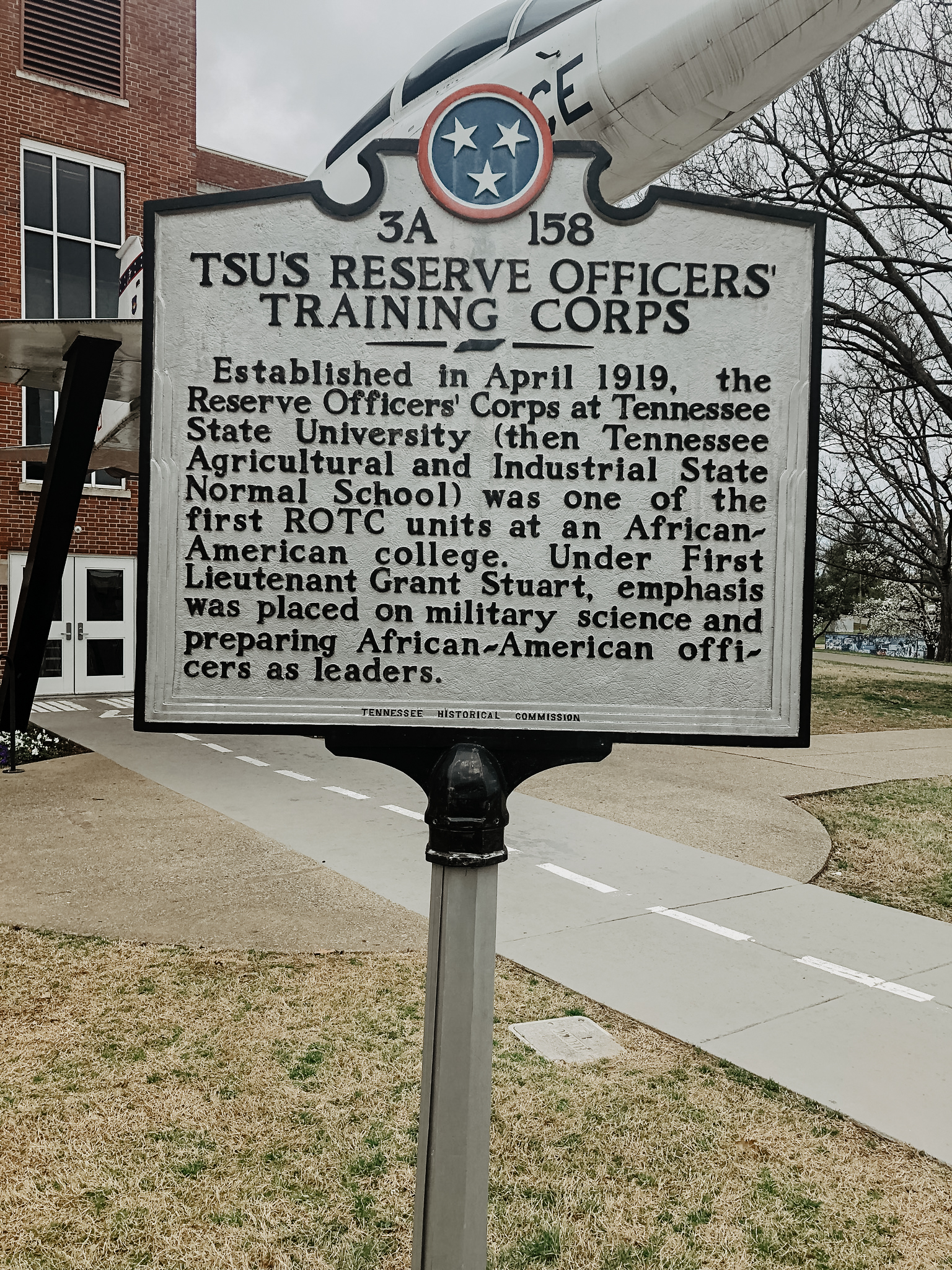


Photograph of the fighter jet outside of Kean Hall, 2019. Image courtesy of Sydney Whitten.
Stop 1 of 18
Kean Hall
Part I.
What do Fig Newtons, reggae music, military service, sports, and Civil Rights have in common? The answer is Kean Hall. Our tour begins under this impressive fighter jet that represents TSU’s proud connection to the Air Force Reserve and its ROTC unit—known as Detachment 790. In 1919, Tennessee A&I established this unit for the purpose of recruiting and training black Air Force officers and aviators. The ROTC program’s first two instructors were former Tuskegee Airmen. This decommissioned plane outside of the current ROTC offices is named for the highest-ranking officer from Detachment 790. You can see the name General Lloyd W. “Fig” Newton emblazoned just below the cockpit. This four-star general was the first African American pilot to become a member of the prestigious Air Force Thunderbirds.
Here you also see a historical marker dedicated to Lieutenant William McBryar. McBryar was born in North Carolina in 1861 at the start of the Civil War. As a child who came of age during the war and its aftermath, McBryar experienced the struggle for black equality first hand. He enrolled at St. Augustine College in North Carolina, but dropped out and enlisted in the U.S. Army in 1887. He served with the US Tenth Calvary, one of the original segregated regiments that became known as the Buffalo Soldiers. Yes, the same Buffalo Soldiers that reggae musician Bob Marley sang about in the early 1980s.
McBryar fought in bloody campaigns against Native Americans in Arizona, as well as the Spanish-American War in Cuba and the Philippines. He was awarded the Congressional Medal of Honor for his service. In his late 60s, McBryar applied and was accepted at Tennessee A&I. In 1934, William McBryar graduated after starting his college career fifty years earlier. He was 73 years old! McBryar’s life should inspire us all to serve others, work hard, and never give up.
Facing 33rd Avenue, turn LEFT and walk around the corner of Kean Hall to its front entrance. There, on your RIGHT, you will see a historic marker for the Negro High School Basketball Tournament. Press pause on the narration and hit play once your reach the marker.
Part II
You are standing in front of the main entrance to Kean Hall. This 1951 Art Deco style building is a large gymnasium—nicknamed “Kean’s Little Garden.” But to be clear, Henry Arthur Kean’s life and legacy was anything but little. From 1944 to 1954, he served as a faculty member, department chair, athletic director, and football coach at Tennessee A&I. Kean’s love of football began at Fisk University in 1916, where he helped the team win the National Black Football Championship. After graduation, Henry Kean joined the armed forces and fought in WWI. Following his service, he coached in Kentucky before returning to Nashville in the 1940s.
During his tenure as head football coach, Kean led the Tigers to five national championships. This facility was the home court for TSU’s basketball teams from 1951 to 1980, and Kean’s Little Garden hosted the National Negro High School Basketball Tournament from 1953 to 1964. Read more about this story on the historical marker to your right. Today, Kean Hall is the home of the women’s volleyball team.
Before we move to our next stop let’s talk about the role of Kean Hall in the Civil Rights movement. Students gathered here on April 19, 1960 and began marching toward City Hall in complete silence following the bombing of Z. Alexander Looby’s home by white supremacists. Other protestors joined as they walked, and by the time they reached the courthouse, the group numbered nearly 3000 people. Student leaders confronted Mayor Ben West, who ultimately said he would support the desegregation of lunch counters. Cupid Poe, student-body president of Tennessee A&I, was part of this transformational event—making Nashville the first major southern city to integrate lunch counters. For more take the Civil Rights Sit-Ins Tour or our upcoming Fisk and Meharry Tour.
Follow the sidewalk up toward the main campus. You will reach the sign for the Floyd-Payne Campus Center. Note the large TSU seal on the building. Turn RIGHT and then LEFT and go up the double staircase. Once you reach the top you will be looking at the Historic District ahead of you. Turn LEFT and stop at the bell clock tower for the next stop.
Tour Stops
Kean Hall
3500 John E. Merritt Boulevard
Floyd-Payne Campus Center and Bell Tower
3500 John E. Merritt Boulevard
Brown-Daniel Library
3500 John E. Merritt Boulevard
Clay Hall
3500 John E. Merritt Boulevard
Strange Performing Arts Center
3500 John E. Merritt Boulevard
Hale Hall, Rudolph Hall, and Torrence Hall
3500 John E. Merritt Boulevard
Boswell Science Complex and Black Greek Letter Organizations
3500 John E. Merritt Boulevard
Holland Hall, Crouch Hall, and Mirrored Lakes
3500 John E. Merritt Boulevard
Research and Sponsored Programs Building
3500 John E. Merritt Boulevard
Elliot Hall, Women's Building, and Van Gordon Art Gallery
3500 John E. Merritt Boulevard
Averitte Amphitheater, Love Building, and Davis Hall
3500 John E. Merritt Boulevard
Harned Hall and Politics
3500 John E. Merritt Boulevard
Goodwill Manor
3500 John E. Merritt Boulevard
Hankal Hall and Queen Washington Building
3500 John E. Merritt Boulevard
Gentry Center
3500 John E. Merritt Boulevard
Olympic Plaza and Statue
3500 John E. Merritt Boulevard
Hale Stadium and Field House
3500 John E. Merritt Boulevard
College of Agriculture
3500 John E. Merritt Boulevard