

.jpg)


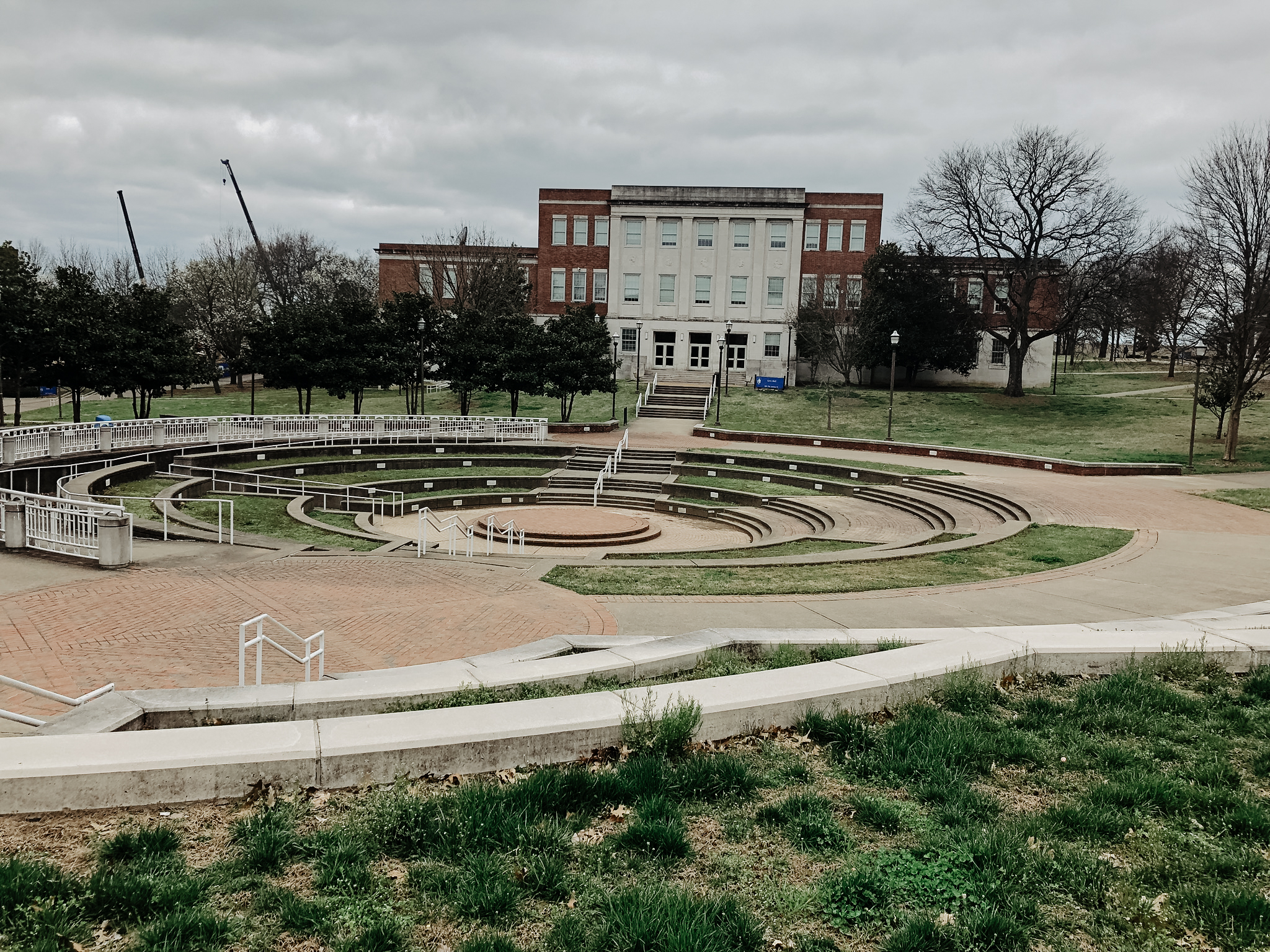
Photograph of Laura Averitte Amphitheater, 2019. The Harold Love Sr. Student Success Center, formerly Memorial Library, and some construction equipment and visible on the other side of the amphitheater. This area was formerly part of Centennial Boulvard, but was closed to traffic in the 1970s. Image courtesy of MHCF.
Stop 11 of 18
Averitte Amphitheater, Love Building, and Davis Hall
Part I
Turn to your right and walk to the east of the Women’s Building, and stand in the middle of the Laura M. Averitte Amphitheater. Take in the historic buildings that surround you, and listen for the lingering voices of lecturers and musical and theater groups that have filled this space for over a century. The Averitte Amphitheater was named for Laura M. Averitte, a 1918 graduate, noted performance artist, and founder of Tennessee State University’s Theater Program. Remember the Bell Tower at the beginning of the tour? It plays TSU’s alma mater each day, and it was none other than Laura Averitte who wrote the lyrics in 1931. The first line, “In the Land of Golden Sunshine, by the Cumberland’s fertile shore”—still elicits a sense of pride in the university by students and alumni alike.
Facing the Bell Tower, turn and look at the building on your left. The Love Building was named for State Representative Harold M. Love—a pioneering North Nashville leader. But for half a century, from 1927 to 1976, this building served as the university’s first library, which you can still see etched in stone across the top. Today, students come to the Love Building for advising, registration, tutoring, and other services to assist with their matriculation through the university.
Harold M. Love, a Tiger alumnus and fierce HBCU advocate, was a local councilman who later served twelve terms in the Tennessee General Assembly. Love was an effective leader who often bridged the gap between Black and white politicians during the era of Jim Crow. Once, he received a call from President Lyndon B. Johnson who sought Love’s endorsement for a candidate for governor. According to the story, Love leveraged the request—agreeing to endorse the candidate only if the president helped to secure the release of TSU students arrested during a Civil Rights protest. Still facing the Bell Tower, turn and look at the building on your right to learn about the second part of this stop.
Part II
To your right is the Walter S. Davis Humanities Building, formerly known as the Administration and Health Building. Walter Strother Davis received his bachelor’s degree from Tennessee A&I and later earned a Ph.D. from Cornell University. In 1933, he returned to TSU as the football coach and also served as professor of agriculture until 1943—at which time he was named TSU’s second president. Dr. Davis ably led TSU for twenty-five years, from 1943 to 1968, and navigated the university through a period of significant growth. In 1958, the school was accredited by the Southern Association of Colleges and Schools and received full university status. The Tennessean called Davis the “guiding force” behind this effort as well as a massive building campaign that resulted in the construction of nearly 70 percent of the buildings you see today on campus. Student enrollment also increased from 1,000 students in 1943 to over 6,000 by 1965.
Dr. Davis’s tenure was not all about growth; it was also about transition and tension during the Civil Rights movement. As the president of one of the country’s leading HBCUs, the African American community placed certain expectations upon him and the university as a whole. These expectations often ran counter to the demands of a state government firmly committed to white supremacy. As the lead administrator of a state-funded university, Davis carried a heavy burden as he attempted to navigate these competing constituents.
Completed in 1935, the Davis Building once housed administrative offices, classrooms, and gym space. Today it houses the Department of Languages, Literature, and Philosophy. Before leaving this stop, notice the clock and iconic cupola of Davis Hall. The clock’s chimes were installed by Nashville’s Claude P. Street Piano Company. They were first used during the homecoming football game in 1949 and rang three times a day until 1965. The chimes provided an audible connection between the residents of the North Nashville community and the TSU community.
Walk to the other side of the Love Building and Averitte Amphitheater and turn LEFT onto the sidewalk with Harned Hall on the corner. This is your next stop.
Tour Stops
Kean Hall
3500 John E. Merritt Boulevard
Floyd-Payne Campus Center and Bell Tower
3500 John E. Merritt Boulevard
Brown-Daniel Library
3500 John E. Merritt Boulevard
Clay Hall
3500 John E. Merritt Boulevard
Strange Performing Arts Center
3500 John E. Merritt Boulevard
Hale Hall, Rudolph Hall, and Torrence Hall
3500 John E. Merritt Boulevard
Boswell Science Complex and Black Greek Letter Organizations
3500 John E. Merritt Boulevard
Holland Hall, Crouch Hall, and Mirrored Lakes
3500 John E. Merritt Boulevard
Research and Sponsored Programs Building
3500 John E. Merritt Boulevard
Elliot Hall, Women's Building, and Van Gordon Art Gallery
3500 John E. Merritt Boulevard
Averitte Amphitheater, Love Building, and Davis Hall
3500 John E. Merritt Boulevard
Harned Hall and Politics
3500 John E. Merritt Boulevard
Goodwill Manor
3500 John E. Merritt Boulevard
Hankal Hall and Queen Washington Building
3500 John E. Merritt Boulevard
Gentry Center
3500 John E. Merritt Boulevard
Olympic Plaza and Statue
3500 John E. Merritt Boulevard
Hale Stadium and Field House
3500 John E. Merritt Boulevard
College of Agriculture
3500 John E. Merritt Boulevard