
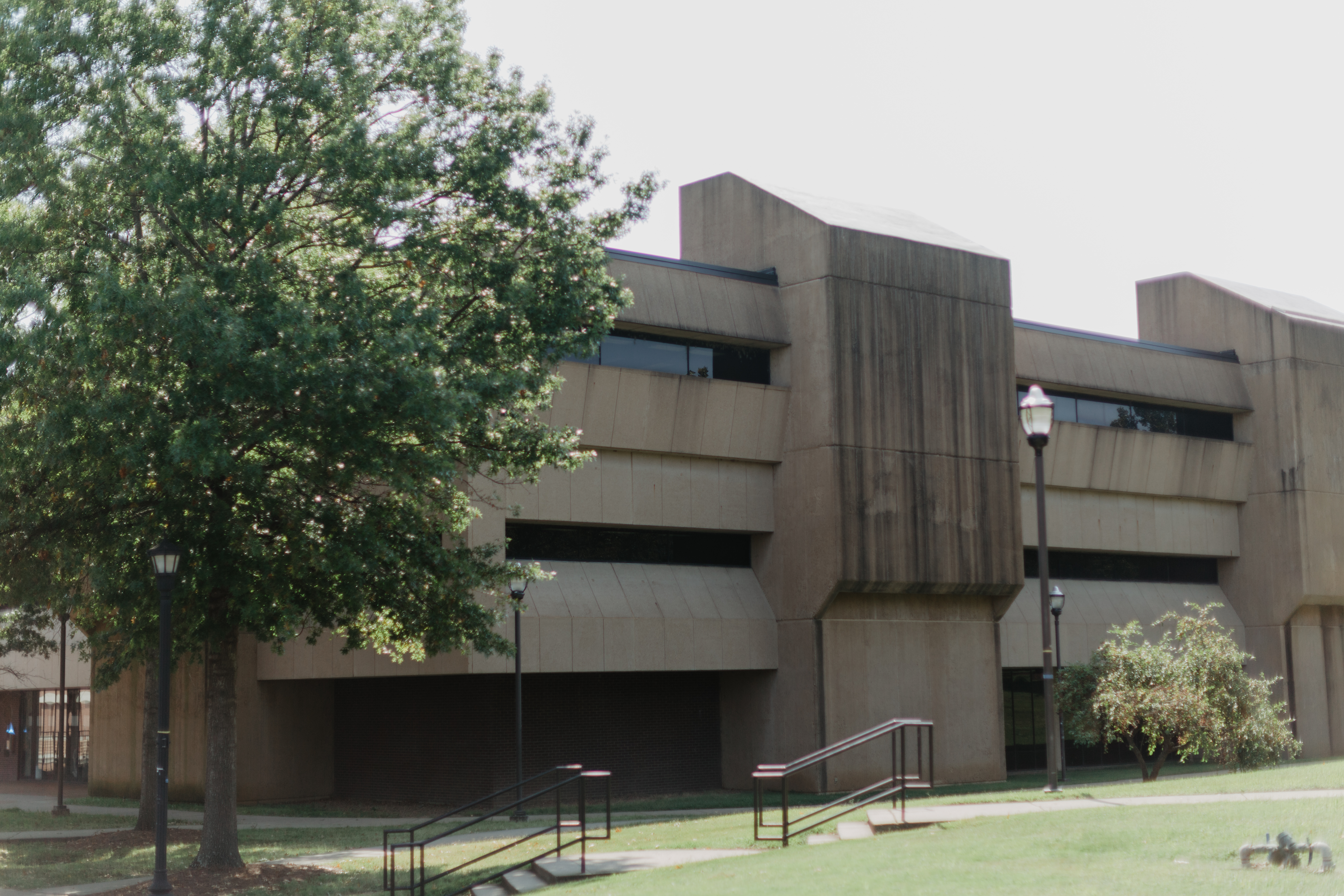
The Brutalist Brown-Daniel Library, 2019. Image courtesy of Sydney Whitten.
Stop 3 of 18
Brown-Daniel Library
The imposing building to your left is the Martha M. Brown and Lois H. Daniel library, built in 1976. If libraries are the heart and soul of higher education, then you could argue that these two women remain as important to TSU’s development and history as its first two presidents, William Jasper Hale and Walter S. Davis. Indeed, their commitment to student learning and research laid the foundation for Tennessee State University’s coveted rating as a Carnegie 2 Research Institution in 2019.
Martha Brown—an alumna of Fisk University—was a founding faculty member of Tennessee A&I State University when it opened its doors in 1912. During her tenure as the school’s librarian from 1918 to 1945, the library grew from a two-room space in the main building to a Georgian-style building, completed in 1927. You will see this 1927 building later in the tour. It was one of the first libraries constructed on a public HBCU campus. By 1949, the library boasted over 120,000 volumes and had a seating capacity for over 600 students.
Brown passed the torch in 1945 to Lois H. Daniel, a 1933 graduate of Tennessee A&I, who became the second head librarian at the university. Under her direction, library holdings expanded to more than 230,000 volumes. It was under Daniel’s tenure that the university organized a Library Services Program to train school librarians. By the time she retired from the university in 1976, TSU was one of the best public HBCU libraries in the South and was in the process of moving to this current facility.
This 82,000-square foot building is formidable—featuring a Brutalist style focused on bold forms that use raw concrete as their primary material. In addition to circulation and reference collections there are classrooms and a Special Collections room that houses the university’s archives and TSU dissertations and theses. The Brown-Daniels Library stands as a monument to the university’s intellectual spirit and as a memorial to the lives of these remarkable women.
Turn RIGHT and cross over to the sidewalk on the other side of the quad. Continue straight as you walk along the sidewalk. Clay Hall, the next stop, will be on your right.
Tour Stops
Kean Hall
3500 John E. Merritt Boulevard
Floyd-Payne Campus Center and Bell Tower
3500 John E. Merritt Boulevard
Brown-Daniel Library
3500 John E. Merritt Boulevard
Clay Hall
3500 John E. Merritt Boulevard
Strange Performing Arts Center
3500 John E. Merritt Boulevard
Hale Hall, Rudolph Hall, and Torrence Hall
3500 John E. Merritt Boulevard
Boswell Science Complex and Black Greek Letter Organizations
3500 John E. Merritt Boulevard
Holland Hall, Crouch Hall, and Mirrored Lakes
3500 John E. Merritt Boulevard
Research and Sponsored Programs Building
3500 John E. Merritt Boulevard
Elliot Hall, Women's Building, and Van Gordon Art Gallery
3500 John E. Merritt Boulevard
Averitte Amphitheater, Love Building, and Davis Hall
3500 John E. Merritt Boulevard
Harned Hall and Politics
3500 John E. Merritt Boulevard
Goodwill Manor
3500 John E. Merritt Boulevard
Hankal Hall and Queen Washington Building
3500 John E. Merritt Boulevard
Gentry Center
3500 John E. Merritt Boulevard
Olympic Plaza and Statue
3500 John E. Merritt Boulevard
Hale Stadium and Field House
3500 John E. Merritt Boulevard
College of Agriculture
3500 John E. Merritt Boulevard